North of the old city walls, a vast oasis of date palms stretches across the plain. The Palmeraie of Marrakech is almost as old as the city itself, and today it is where travellers come for a first camel ride, a quad excursion or a quiet escape among the trees.
1. The origins of the Palmeraie
The palm grove dates from the 11th century, when the Almoravid dynasty founded Marrakech. To make an oasis in a dry plain, engineers dug khettaras, long underground channels that carry water from the foot of the Atlas by gravity alone. The same system can still be seen in the oases of the south.
At its height the grove covered well over ten thousand hectares, with more than a hundred thousand palms shading orchards and vegetable gardens.
2. How a khettara works
A khettara is a gently sloping tunnel dug from the plain back towards the mountains until it meets the water table. Water then flows out by gravity, with no pump, to the fields and gardens. A line of well shafts, spaced every few metres along its length, let the diggers remove earth and later clean the channel.
Marrakech once depended on hundreds of these tunnels. Most ran dry in the 20th century as motor pumps lowered the water table. If you travel to the desert, you will pass a field of old khettaras near Erfoud, where you can climb down into one.
3. The legend of the date stones
Marrakchis tell a story about how the grove began. The soldiers of the Almoravid sultan Youssef ben Tachfine, camped outside the new city, ate dates brought from the Sahara and threw the stones on the ground. The stones fell into the holes left by their lances and took root, and so the palm grove was born. It is only a legend, but it captures the link between Marrakech and the desert.
4. The date palm, tree of life
In an oasis, the palm is the roof under which everything else grows. Its crown shades fruit trees such as olives, figs and pomegranates, which in turn shelter vegetables and cereals at ground level. Nothing is wasted: trunks become roof beams, fronds are woven into baskets and fences, and the dates feed people and animals alike.
5. Things to do in the palm grove
Most people come for a couple of hours on an organised excursion. These are the usual options.
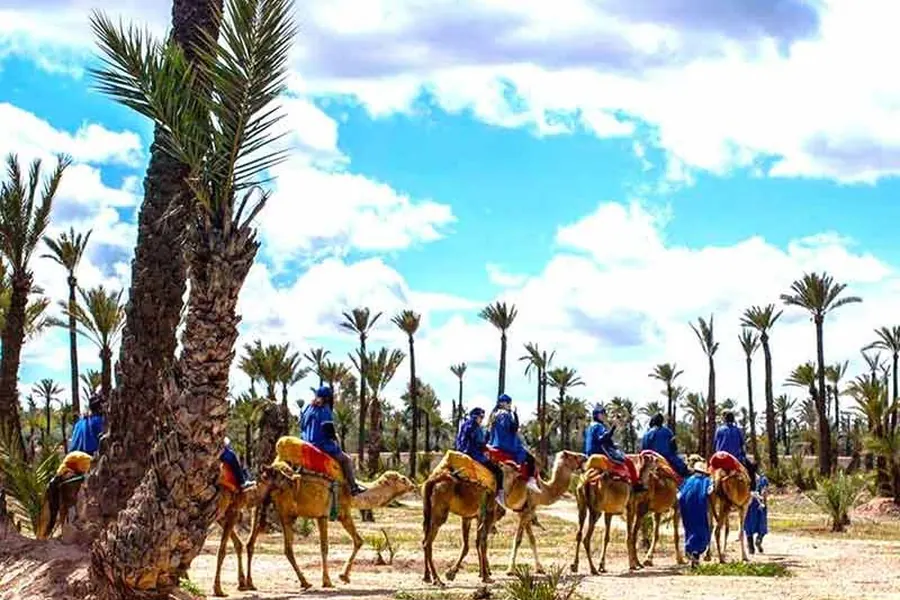
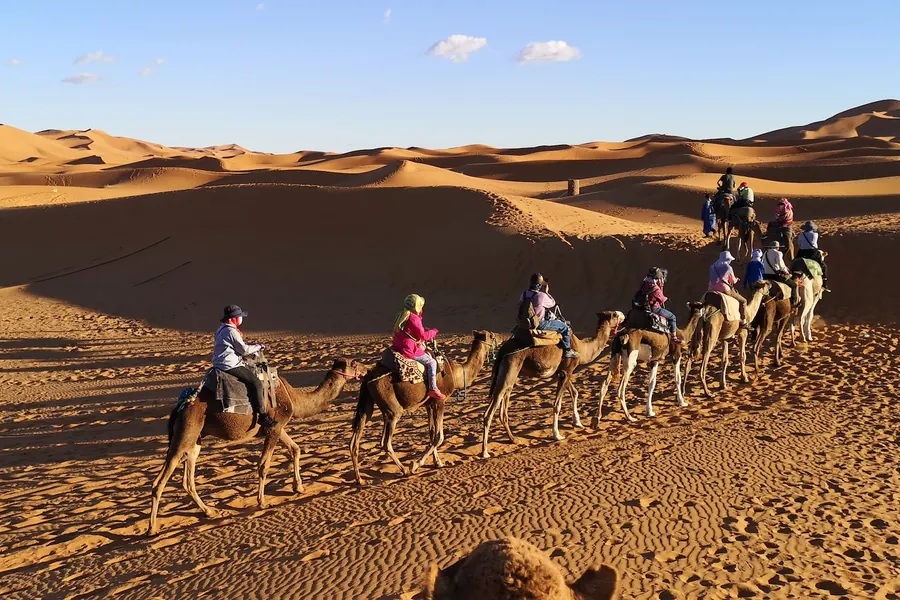
- Camel ride: A gentle walk of an hour or so among the palms, usually with a stop for mint tea. Sunset is the nicest time.
- Quad biking: Guided circuits on tracks through the grove and the rocky desert beyond.
- Cycling: Flat lanes make for an easy ride, best in the cool of the morning.
- Horse-drawn carriage: A slow tour from the city in a calèche.
- Tea in a Berber house: Many excursions include a visit to a family home.
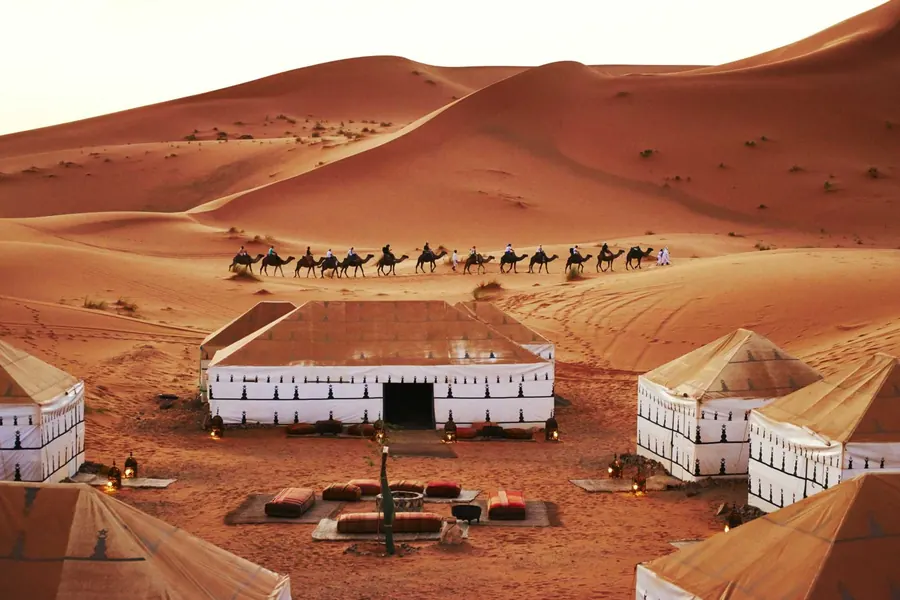
Local tip: A camel ride here is fun, but it is not the Sahara. If you want real dunes, you need to travel south to Zagora or Merzouga.
6. Camel ride or quad: what to expect
For a camel ride, you are collected from your hotel and driven to a meeting point in the grove, where guides hand out blue robes and turbans for the photographs. The camels walk in a line at a gentle pace for about an hour, with a stop for tea and pancakes at a village house.
Quad excursions begin with helmets and a short briefing, then follow dirt tracks through the palms and across the open stony ground for one to two hours. It is dusty, so wear closed shoes, sunglasses and a scarf. Drivers usually need to be at least sixteen; younger children ride as passengers.
7. Palmeraie or Agafay?
These are the two half-day escapes from Marrakech, and people often ask which to choose. The Palmeraie is closer, flatter and greener, and suits families and anyone short of time. Agafay, forty-five minutes away, is a wide landscape of bare, pale hills with the Atlas behind, better for sunsets and dinner in a camp. Neither has sand dunes.
8. The Palmeraie today
In recent decades part of the grove has been built over with villas, hotels and golf courses, and many palms have suffered from drought. Replanting programmes are trying to restore it, and the area is protected. It remains a pleasant contrast to the bustle of the medina, particularly if you are staying in one of its resorts.
9. Staying in the Palmeraie
The grove is home to many of Marrakech's resort hotels and private villas, with large gardens and pools that a medina riad cannot offer. It is a good choice in the hot months or with children. The trade-off is distance: every visit to the souks or Jemaa el-Fna means a taxi ride, so many travellers split their stay between a riad and a resort.
10. A responsible visit
The grove is a fragile place and people live in it. A few courtesies go a long way.
- Choose operators who treat their animals well: camels should look healthy, rested and unhurried.
- Stay on the tracks when riding a quad, and keep your speed down near houses.
- Take your rubbish with you.
- Ask before taking photographs of local families.
11. How to get there
The Palmeraie lies about 10 km north-east of the medina, 20 minutes by taxi. Most activities include hotel pick-up, which is the easiest way to visit.
Frequently Asked Questions
How long is a camel ride in the Palmeraie?
Usually one to one and a half hours, including a tea stop.
Is the Palmeraie worth visiting?
As a short activity from Marrakech, yes, especially for families. As a sight in itself, it is modest; the great palm groves of the Drâa Valley and Skoura are far more impressive.
Do the palms produce dates?
Some do, though the best Moroccan dates come from the Drâa Valley and the Tafilalet, around Erfoud and Rissani.
What is the best time of day for a camel ride?
Late afternoon, for the soft light and the sunset behind the palms. In summer, early morning is cooler.
Is the Palmeraie suitable for young children?
Yes. The ride is slow and short, and small children can share a camel with a parent.
See It on One of Our Tours

Written by the Desert Merzouga Tours teamLocal guides and drivers from the Moroccan Sahara. Meet our team or ask us a question.