With sixteen days you can see Morocco the way it should be seen: slowly. This route starts on the northern coast with two nights in Tangier and a day in the artists' town of Asilah, then settles for two nights in Chefchaouen, with time to walk in the Rif.
It continues down the Atlantic through Rabat and Casablanca before turning inland to Meknes, Volubilis and Fes. From there you cross the Middle Atlas to Merzouga for two nights at the dunes, and travel west through the gorges with nights in the Dades Valley and Ouarzazate.
The journey ends with two nights in Marrakech and a final night by the ocean in Essaouira. Most driving days are under five hours, and several days have no driving at all.
Best for: Travellers with plenty of time who prefer two nights in each key place to a different bed every evening.
Duration16 Days / 15 Nights
StartsYour hotel, the port or the airport in Tangier
EndsMarrakech airport
Departure8:00 am
GroupPrivate: only your party
Tour typeGrand Morocco tour
Tour Highlights
Tangier, Cap Spartel and the painted walls of Asilah
Two nights in Chefchaouen, with a walk to the Akchour waterfalls
Rabat's royal monuments and the Hassan II Mosque
Meknes, Volubilis and a guided day in Fes
Two nights in Merzouga with camel trek and 4x4 day
Dades, Ouarzazate, Aït Benhaddou, Marrakech and Essaouira
Day-by-Day Itinerary
01Day 1Welcome to Tangier
Tangier · medina · Kasbah Museum · American Legation · About 30 minutes of driving
After we meet you at the port or airport, the afternoon is given to Tangier's old town. Climb to the kasbah and the former sultan's palace, now a museum of Mediterranean cultures, and find the terrace beside it that looks straight across to Europe.
Down in the medina, the American Legation recalls that Morocco was the first country to recognise the United States; the building is the only American national historic landmark abroad. Dinner is at your leisure, perhaps fresh fish near the harbour.
Kasbah of Tangier
Kasbah Museum
American Legation
Medina and harbour
Overnight: Hotel or riad in Tangier
Meals: Dinner at your leisure
02Day 2Cap Spartel, the Caves of Hercules and Asilah
Tangier · Cap Spartel · Caves of Hercules · Asilah · Tangier · About 2 hours of driving
A day on the Atlantic. Drive first to the headland of Cap Spartel and the sea caves where legend says Hercules rested after separating Europe from Africa. Then follow the coast south for 45 minutes to Asilah.
This small fishing town sits inside ramparts built by the Portuguese in the 15th century. Its houses are white with blue and green shutters, and each summer artists cover the walls with new murals. Walk out along the sea bastion, have lunch by the gate and return to Tangier in the late afternoon.
Cap Spartel lighthouse
Caves of Hercules
Asilah ramparts
Asilah murals
Overnight: Hotel or riad in Tangier
Meals: Breakfast
03Day 3Tetouan and the Rif mountains to Chefchaouen
Tangier · Tetouan · Chefchaouen · About 2.5 hours of driving
Leave Tangier for Tetouan, the 'white dove' of the north. Its medina was built by Muslim and Jewish families expelled from Granada, and their descendants still live in its tall whitewashed houses. Visit the craft school if it is open, where young apprentices learn woodcarving, embroidery and tilework.
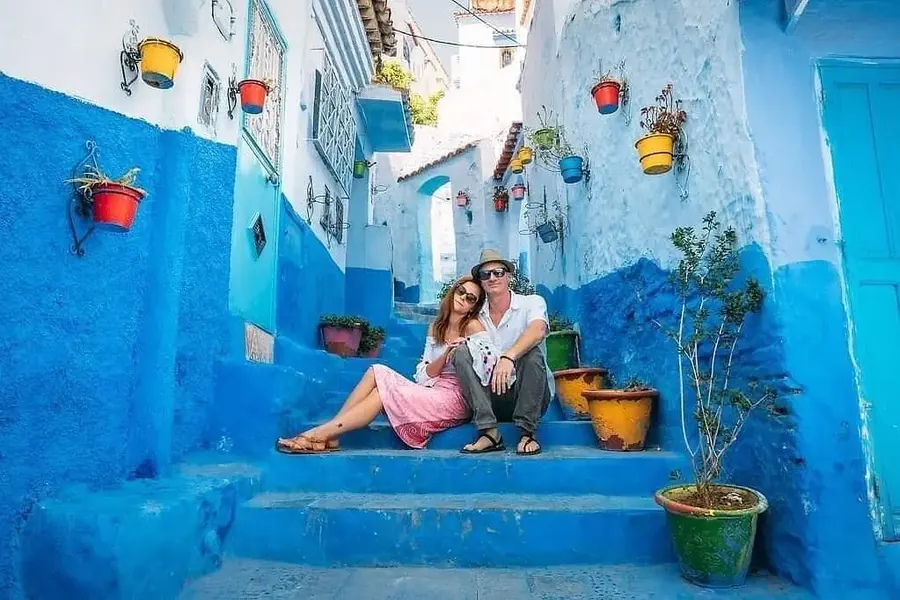
The mountain road reaches Chefchaouen by mid-afternoon. Settle into your riad for two nights and take a first walk through the blue lanes to the main square.
Tetouan medina (UNESCO)
Tetouan craft school
Chefchaouen medina
Overnight: Riad in Chefchaouen
Meals: Breakfast
04Day 4A free day in Chefchaouen and the Rif
Chefchaouen · Akchour (optional) · No driving (1.5 hours if you visit Akchour)
No driving is planned today unless you want it. Many guests simply enjoy the town: breakfast on a roof terrace, a visit to the kasbah museum, a slow climb to the Spanish Mosque for the view, and an afternoon of browsing woollen blankets and goat's cheese in the market.
If you like to walk, your driver can take you to Akchour, 45 minutes away, where a trail follows a clear river to a series of waterfalls and to the natural rock arch known as God's Bridge.
Kasbah museum
Spanish Mosque viewpoint
Akchour waterfalls (optional)
Local market
Overnight: Riad in Chefchaouen
Meals: Breakfast
05Day 5From the Rif to the capital
Chefchaouen · Ouezzane · Kenitra · Rabat · About 4 hours of driving
Descend from the mountains through Ouezzane, a town of olive presses and weavers, and across the fertile Gharb plain to the Atlantic. You reach Rabat in the early afternoon.
Begin at the Hassan Tower, the minaret of a mosque planned in the 12th century to be the largest in the world, and the white mausoleum that faces it. Then walk through the Kasbah of the Udayas to the terrace above the river mouth, and take tea in the Andalusian garden.
Ouezzane
Hassan Tower
Mausoleum of Mohammed V
Kasbah of the Udayas
Overnight: Hotel or riad in Rabat
Meals: Breakfast
06Day 6Chellah and south to Casablanca
Rabat · Chellah · Casablanca · Hassan II Mosque · Corniche · About 1.5 hours of driving
Spend the morning at Chellah, where the ruins of a Roman town and a medieval royal cemetery share a walled garden full of storks. Then drive an hour down the coast to Casablanca, the country's largest city and business capital.
Visit the Hassan II Mosque on a guided tour of the prayer hall and ablution rooms. The building stands partly over the ocean, and its craftsmanship in marble, cedar and zellige is extraordinary. Later, see the Art Deco facades around Mohammed V Square and walk the seafront.
Chellah necropolis
Hassan II Mosque
Mohammed V Square
Corniche
Overnight: Hotel in Casablanca
Meals: Breakfast
07Day 7Inland to Meknes, Volubilis and Fes
Casablanca · Meknes · Volubilis · Fes · About 5 hours of driving
Take the motorway inland to Meknes. Sultan Moulay Ismail spent half a century building this city, and what remains is on a giant's scale: gates, walls within walls, a mausoleum and granaries cooled by water channels beneath the floor.
A short drive north brings you to Volubilis, where a guide explains the Roman streets, oil presses and mosaics. From the ruins you can see Moulay Idriss, the holy town on its twin hills. Continue to Fes for two nights.
Bab Mansour
Mausoleum of Moulay Ismail
Volubilis (UNESCO)
Moulay Idriss viewpoint
Overnight: Riad or hotel in Fes
Meals: Breakfast
08Day 8A guided day in Fes
Fes el-Bali · Fes el-Jdid · Borj Sud · pottery quarter · Walking tour
Fes repays a whole day on foot. With your guide, see the palace gates and the Mellah, look over the medina from Borj Sud and visit a workshop where mosaics are assembled piece by piece. Then go in through Bab R'cif or Bab Boujloud and let the city swallow you.
The route passes the Attarine Madrasa, the spice and henna souks, the brass workers of Seffarine and the tanneries. Lunch is in a restored house in the medina, and your guide returns you to your riad by late afternoon.
Royal Palace gates
Borj Sud
Zellige workshop
Attarine Madrasa
Chouara tannery
Overnight: Riad or hotel in Fes
Meals: Breakfast
09Day 9Over the Middle Atlas to the Sahara
Fes · Ifrane · Azrou · Midelt · Ziz Valley · Erfoud · Merzouga · Erg Chebbi · About 7 hours of driving
Set out for the south through Ifrane and the cedar forest. The trees here can live for eight hundred years, and troops of macaques forage beneath them. Beyond the forest the road crosses open country to Midelt, where you stop for lunch.
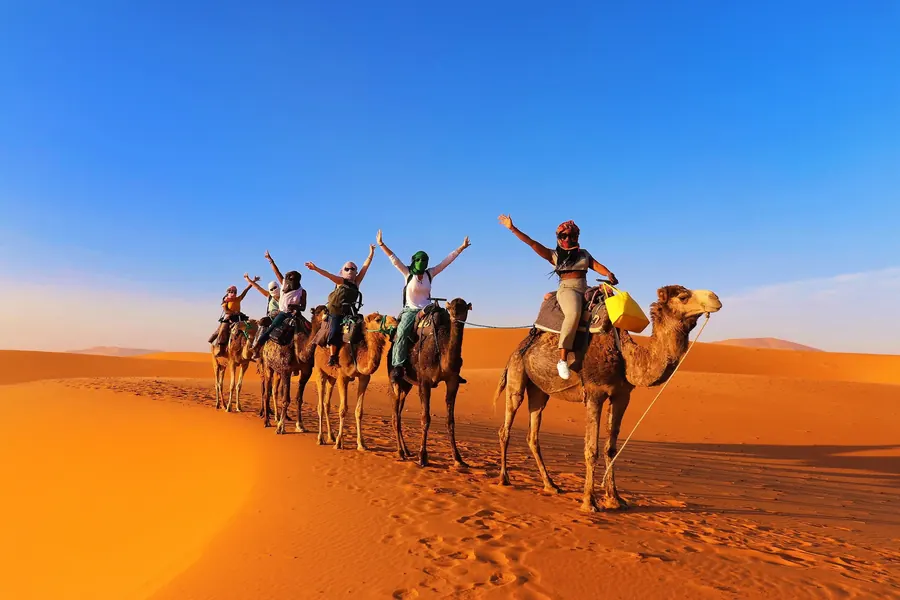
The descent through the Ziz Gorges brings the first palm groves and the first real heat. In Merzouga, your camel is ready: ride for an hour and a half into Erg Chebbi, watch the sunset from the sand and sleep in a desert camp.
Ifrane
Ancient cedars and macaques
Midelt
Ziz Gorges
Sunset camel trek
Overnight: Desert camp in Erg Chebbi
Meals: Breakfast · Dinner
10Day 10Merzouga: nomads, music and the black desert
After sunrise on the dunes and breakfast at camp, explore the country around Erg Chebbi in a 4x4. The tracks cross the hamada, the black stone desert, to nomad tents, to the mining ruins of M'ifis and to Khamlia, where Gnawa families keep alive the music of their ancestors.
When there has been rain, the lake of Dayet Srij fills and flamingos arrive. The afternoon is free at your hotel beside the dunes; sandboards are available, and the pool is welcome in the warmer months.
Sunrise
Black desert tracks
Nomad family
Khamlia Gnawa music
Dayet Srij lake
Overnight: Hotel in Merzouga
Meals: Breakfast · Dinner
11Day 11Todra Gorge and the Dades Valley
Merzouga · Erfoud · Tinghir · Todra Gorge · Dades Valley · About 5 hours of driving
Drive west with the Atlas on your right and the desert on your left. In Erfoud, see how slabs of black marble full of fossils are cut and polished. Tinghir comes next, with its old Jewish quarter and terraced palm gardens.
Walk through the Todra Gorge, then follow the Dades river upstream past the Monkey Fingers rocks to the upper gorge. Your hotel has a terrace over the valley, a fine place to watch the cliffs change colour at sunset.
Erfoud fossil workshop
Tinghir
Todra Gorge
Monkey Fingers
Dades Gorge
Overnight: Hotel in the Dades Valley
Meals: Breakfast · Dinner
12Day 12The Valley of Roses and Skoura to Ouarzazate
Dades Valley · Kalaat M'Gouna · Skoura · Ouarzazate · About 2.5 hours of driving
An easy day. Stop in Kalaat M'Gouna to see how rose petals are distilled, and walk in the palm grove of Skoura, where paths lead between irrigation channels to Kasbah Amridil, lived in by the same family for three centuries.
Reach Ouarzazate after lunch. Visit the Taourirt Kasbah, a labyrinth of rooms that once belonged to the Glaoui clan, or tour the Atlas Studios, whose sets have stood in for Egypt, Tibet and ancient Rome.
Rose distillery
Kasbah Amridil
Taourirt Kasbah
Atlas Studios
Overnight: Hotel in Ouarzazate
Meals: Breakfast · Dinner
13Day 13Aït Benhaddou and over the Atlas to Marrakech
Ouarzazate · Aït Benhaddou · Telouet · Tizi n'Tichka · Marrakech · About 5 hours of driving
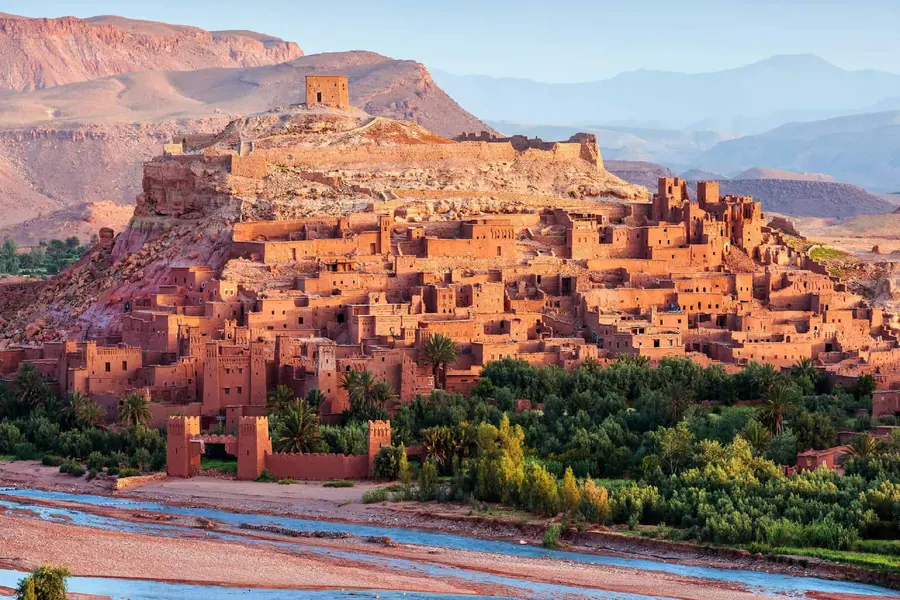
Arrive at Aït Benhaddou in the morning, before the day visitors, and walk up through the ksar in the best light. Then take the back road through the Ounila Valley to Telouet and the kasbah of the last great lords of the Atlas.
Rejoin the main road at the Tizi n'Tichka pass and descend the northern side of the mountains, green where the south was red. You are in Marrakech by late afternoon, with two nights ahead.
Aït Benhaddou (UNESCO)
Ounila Valley
Telouet kasbah
Tizi n'Tichka pass
Overnight: Riad or hotel in Marrakech
Meals: Breakfast
14Day 14A guided day in Marrakech
Marrakech medina · palaces · souks · Walking tour
Meet your city guide after breakfast. Visit the Bahia Palace and the ruins of El Badi, once called the Incomparable, then the Saadian Tombs and the gardens around the Koutoubia. The souks fill the afternoon: spices at Rahba Kedima, slippers, brass, wool still dripping from the dyers' vats.
The evening belongs to Jemaa el-Fna. Eat at one of the numbered stalls, listen to the musicians and watch the storytellers gather their circles, as they have for centuries.
Bahia Palace
El Badi Palace
Saadian Tombs
Souks
Jemaa el-Fna
Overnight: Riad or hotel in Marrakech
Meals: Breakfast
15Day 15West to the ocean: Essaouira
Marrakech · argan forest · Essaouira · About 3 hours of driving
Drive west across the plain to the Atlantic. Halfway, the argan forest begins, and you may see goats standing in the branches of the trees. A women's cooperative shows how the nuts are cracked and ground for oil.
Essaouira appears suddenly: white walls, blue boats and a line of surf. Walk the ramparts and their bronze cannons, visit the harbour when the catch comes in, and have grilled fish for dinner. The medina is small, flat and relaxed after the intensity of Marrakech.
Argan cooperative
Skala de la Ville ramparts
Fishing harbour
Essaouira medina
Overnight: Riad in Essaouira
Meals: Breakfast
16Day 16Essaouira to Marrakech and departure
Essaouira · Marrakech · Menara airport · About 3 hours of driving
Take a last walk on the beach or through the woodworkers' workshops under the ramparts, then drive back to Marrakech. We plan the departure time around your flight.
Your driver-guide takes you directly to Menara airport, or to a hotel if you are staying on. With an early flight, we suggest spending this last night in Marrakech instead and visiting Essaouira as a day trip.
Essaouira beach
Airport transfer
Meals: Breakfast
What's Included
Included
Pick-up and drop-off at your hotel, riad or airport
English-speaking driver-guide for the whole trip
Private minivan or 4x4 with air conditioning and fuel
Hotel and riad nights (where the itinerary includes them)
A night in a desert camp (mid-range luxury or luxury camp)
One camel per person for the desert trek
Mint tea, sandboarding and Berber music at camp
Daily breakfast, plus dinner in the desert and at southern stops (Merzouga, Dades, Ouarzazate, Zagora, Midelt)
Photo stops and breaks wherever you want them
Guided tours of the Fes and Marrakech medinas
Not included
Flights
Lunches
Dinners in the cities (free to choose your own restaurants)
Drinks
Monument and museum entrance fees
Tips
Choose Your Desert Camp
Every tent is private. Pick the comfort level that suits you; tell us your choice when you book.
Mid-range luxury camp
Private tents with their own en-suite bathroom, offering a good balance between comfort and the authentic feel of a Berber camp.
Private tent with en-suite bathroom
Hot showers
Comfortable bedding
A good balance between comfort and authenticity
Most comfortable
Luxury camp
Spacious, elegantly furnished tents equipped with air conditioning and heating, so you stay cool on summer nights and warm in winter. Ideal for couples and families.
Air conditioning and heating in every tent
Private en-suite bathroom with hot shower
Premium bedding and elegant furnishings
Dinner, breakfast and campfire
Good to Know
Entrance fees to monuments and museums are not included.
For flights before mid-afternoon on the last day, we recommend spending the final night in Marrakech.
Any night can be added or removed; this is a private tour.
Frequently Asked Questions
Can I change this itinerary?
Absolutely. Every tour is private, so you can add or remove nights, change the camp style, combine routes or start on a different date. Tell us what you have in mind and we will adapt the plan and price.
What kind of vehicle will we travel in?
A private, air-conditioned minivan or 4x4, depending on group size. Our vehicles are under five years old, regularly inspected and insured for tourist transport.
Is this tour suitable for children?
Yes, families travel with us often. Children love the camel ride and the camp. For young children we usually recommend a longer version of the route, with shorter driving days.
What should I pack?
Comfortable clothes, a warm layer for the evenings, a hat or scarf, sunglasses, sun cream and closed shoes. For the desert night, a small backpack is enough; your main luggage stays safely in the vehicle.
What is the difference between the mid-range luxury and the luxury camp?
Both camps have private tents with en-suite bathrooms, hot showers and comfortable bedding. The mid-range luxury camp offers a good balance between comfort and authenticity. The luxury camp adds air conditioning and heating in every tent, plus more spacious, elegantly furnished tents, so you stay comfortable on hot summer nights and cold winter ones.
The fastest way from the Strait of Gibraltar to Marrakech by way of the Sahara: Chefchaouen, a night in Fes, a camel ride and camp in Erg Chebbi, the gorges and Aït Benhaddou.
North to south in nine days: Tangier, Tetouan and Chefchaouen, Volubilis and a guided day in Fes, a night in the Merzouga dunes, the kasbah road to Marrakech and a finish in Casablanca.
Ten days from Tangier to Marrakech with time to breathe: Chefchaouen, two nights in Fes, two nights at the Merzouga dunes with a 4x4 day, the gorges of the south and two nights in Marrakech.
A one-way crossing that turns a long transfer into an adventure: kasbahs, the Dades and Todra gorges, a camel ride into Erg Chebbi, then cedar forests on the road to Fes.